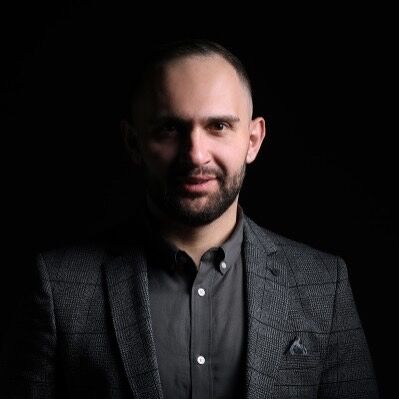
Start with the customer. Reason from first principles. Build with agents.
Milad Aslaner. Defended with security products before building them.
How I build
Pick the destination first. Then four ways I get there.
Scroll to move through all five, or pick one.
Before anything gets built, I pin down exactly who we build for, where we want to be in a few years, and the one thing we win on: customer intimacy, product leadership or operational excellence. Focus means saying no to good ideas that don’t get us there.
WhyThe first release is a stepping stone. Netflix began by mailing DVDs but picked its name for the internet age it expected. DVDs built the customer base; streaming was always the destination.Read: The power of saying ‘no’ →
Understand exactly what one user does all day and what they need. Describe the end state we want to enable for them, then build the product and technology plan backwards from it.
WhyMost products are built inside out, from a feature list. Starting from the customer’s reality is how you build something they actually use.
Question every requirement and delete before you optimise; the best requirement is the one you remove. Then reason from what is true: data volume, the cost to store, query and run AI on it, and how much time analysts really have.
WhyBest practice is just what the last vendor did. Designing from the facts is how you find architectures and economics that get better as customers grow, not more expensive.
Bring customers and partners in early as design partners, put working prototypes in their hands and iterate in weeks, not quarters. It is judged in their environment, not in a demo.
WhyIt is the fastest way to build confidence in product-market fit. When design partners rely on it in their own environment, you know you are building the right thing before you scale it.Read: Continuous feedback and rapid iteration →
Success is customers deploying it and buying it, not the GA date. That takes the whole company ready on day one: sales can pitch it, sales engineers can prove it, customer success can deploy it and support knows what to expect.
WhyA GA nobody deploys is a cost, not a win. I judge a product by adoption and revenue, not by its release date, and I build go-to-market readiness into the plan from the start.
Agentic development
transformations
I transform product teams to build with agents, end to end. Product managers, designers and engineers become product builders.
| What changes | Before | After |
|---|---|---|
| How work starts | A requirements document nobody can test | A working prototype. Then requirements locked for scale, reliability, security and observability. |
| Who builds | Separate roles with handoffs in between | Product builders: product managers, designers and engineers who ship with agents. |
| Where agents work | A chatbot on the side | Across the whole product org: specs, design, code, tests, review and documentation. |
| How you grow output | Hire more people to ship more | Same people, more output. Prototypes in days, not quarters, paid for from existing budget. |
| How the change is led | A mandate from the top | Side by side with the product org, building it together, not from above. |
I’ve led this change from the inside, across entire product orgs, side by side with the people doing the work.Read: The product org chart is dead →
Where I’ve built
Building at a hyperscaler, in hypergrowth and under private equity are three different jobs. Each one changes what good looks like.
- HyperscalerMicrosoft
- HypergrowthSentinelOne, through its IPO
- Private equityGuardsix
- HardwareMicrosoft Surface
- SoftwareCloud-native: Microsoft 365 Defender, SentinelOne AI SIEM, XDR, Threat Intelligence and Data LakeOn-premises: Guardsix SIEM, NDR and SOAR
- United States
- Ireland
- Germany
- Turkey
- United Arab Emirates
- Remote-first
- Hybrid
- In person
Publications, patent and talks
What I’ve written, invented and said in public.
Books
- Cybersecurity Strategies and Best Practices
- Hands-On Cybersecurity for Architects
- Hands-On Cyber Security for Finance
- Learn Social Engineering
Patent
- Systems, methods and devices for risk-aware and adaptive endpoint security controlsUS20240089273A1. Patent application, published 2024. Sole inventor.
Podcasts
- Geopolitics and the modern cyber threatTales from the CyberLab, 2026
Articles
- How the US plan to fight transnational cyber crime affects youGuardsix blog, 2026
- The product org chart is dead. Here’s what replaces itLinkedIn, 2026
- The power of saying ‘no’: why prioritization drives real resultsLinkedIn, 2024
- Optimizing signal-to-noise ratio in cybersecurity systemsLinkedIn, 2024
- The role of continuous feedback, rapid iteration and customer-centric developmentLinkedIn, 2024
- CISO quick wins: harnessing the power of automation and AISentinelOne blog
- What is OCSF (Open Cybersecurity Schema Framework)?SentinelOne blog, with Owen Connolly
- Announcing leading zero trust partnerships for XDR-powered autonomous responseSentinelOne blog, with Jeremy Goldstein
- Unify the analyst experience with Singularity Operations CenterSentinelOne blog, with Itay Argoety
- AI: end of the SOC as we know it?Infosecurity Magazine, 2021
- Why AI and automation provide superhuman securityInfosecurity Magazine, 2021
Talks, panels and webinars
- CADA and cybersecurity: what the EU’s Cloud and AI Development Act means for youGuardsix webinar, 2026
- Let’s chat about GPT: the AI arms racePanel, Armorblox CONTEXT at RSAC, 2023
- Navigating top cyber risks and regulatory requirementsRSA Conference, 2023
- Demystifying zero trustEuropean Identity and Cloud Conference, 2022
- A day in the life of a SOC analystMENA Information Security Conference and VirtuPort, 2021
- Microsoft 365 Defender: unleash the NinjaCat in youUK Cloud Infrastructure User Group, 2020
- Azure Sentinel, Defender ATP and the future of IoTQuorum Cyber conversation
- Simplifying Surface imaging with the Surface Deployment AcceleratorMicrosoft Mechanics, 2016
- More than fifty talks, including Black Hat and GISEC